

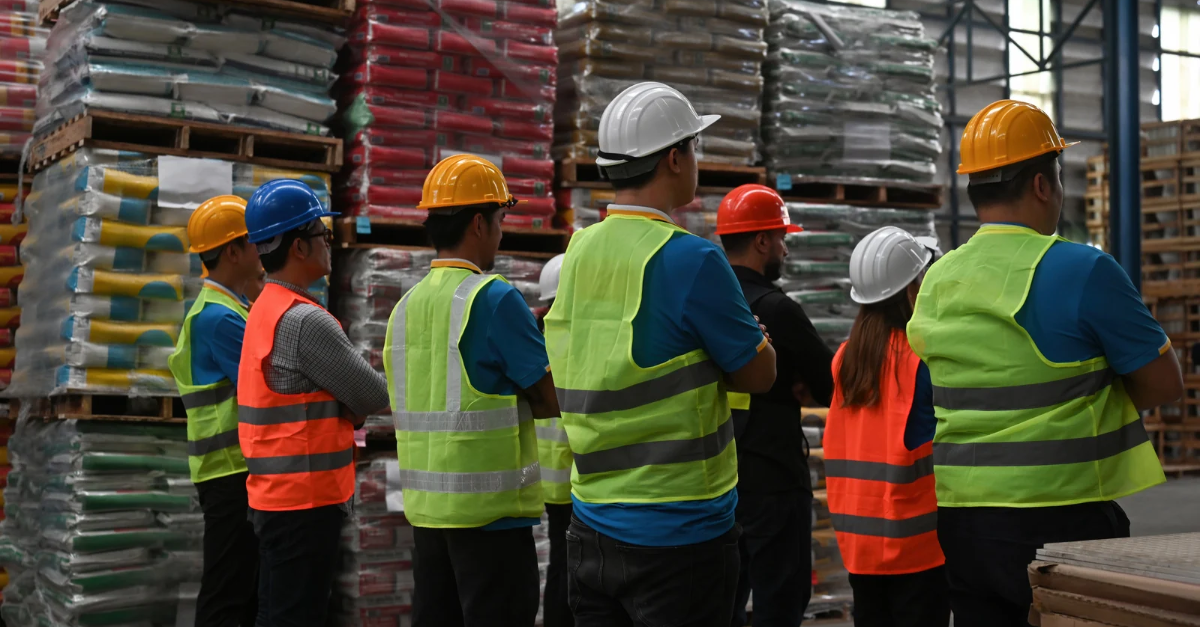


Canada’s top court recently reminded employers (including construction contractors) that the occupational health and safety laws applicable to employers at a workplace may depend on the nature of the project. Projects related to airports, railways, interprovincial transportation, telecommunications, and other federally regulated industries will generally be subject to federal statutory jurisdiction. Contractors working on the project will need to consider whether they remain under provincial laws as is normal for them or are covered by federal laws based on the structure of their business and their involvement with the project. The party with overall responsibility for the project will also need to consider how best to coordinate compliance with safety laws where multiple employers governed by different safety laws are working on the project.
The question of jurisdiction matters. In British Columbia, the provincial Workers Compensation Act and the federal Canada Labour Code have different statutory requirements concerning OHS standards, reporting requirements, enforcement mechanisms, and whether it is possible to designate one employer as a ‘prime contractor’ responsible for coordinating health and safety activities and ensuring compliance at the workplace.
By default, construction is presumed to be under provincial jurisdiction (such as WorkSafeBC in British Columbia), even on federal land or at a marine terminal. A contractor only falls under the Canada Labour Code (federal jurisdiction) if it meets specific functional criteria.
The Two-Step Constitutional Test
Regulators and courts apply two tests in sequence to make this determination:
- The Primary Business Test (Direct Jurisdiction)
First, regulators look at the core, ongoing nature of the contractor’s business—not the single project it is currently working on:
- Provincial: If the company is a general construction, electrical, excavation, or paving firm whose normal business is building projects across various sectors, its primary business is provincial.
- Federal: If the contractor’s core business itself is a federal undertaking (for example, a specialized marine dredging company operating vessels in navigable waters, or a railway track maintenance company working across provincial borders), it is directly under federal jurisdiction.
- The Derivative Jurisdiction Test (Integral Part)
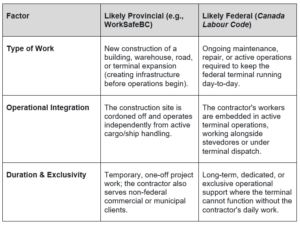
If the contractor’s primary business is provincial, regulators next ask whether the specific work being performed on the terminal is an “integral, vital, or essential part” of the core federal undertaking (e.g., marine shipping and navigation). Courts weigh several practical factors:
The SGS Decision
The Supreme Court of Canada’s recent decision in Quebec v. SGS Canada Inc., 2026 SCC 37 (“SGS”) reminds employers that the question of jurisdiction can be complex.
The decision headnote summarized the facts as follows: SGS is a testing, inspection and certification company servicing different industries in Canada. The company’s Agriculture and Agri-Food Division is its only division focused on agriculture, and it performs 80 percent of the testing for the entire Canadian grain market (“Division”). The Division has eight branches across Canada, including one in Quebec, located in Montréal, which serves as an independent inspection and monitoring body that issues compliance certificates in SGS’s name (“Branch”). The Branch employs 14 grain inspectors and graders and works almost exclusively for six grain elevators along the St. Lawrence River in Quebec. The elevators are all subject to federal jurisdiction. The elevators are operated by companies which are licensed grain elevator operators. The Montréal grain elevator is the Branch’s largest client.
The majority of the Court held that SGS did not itself operate the elevators, so direct federal jurisdiction did not apply merely because its services were closely connected to their operations. The Court did find that derivative jurisdiction applied to SGS’s Montréal Branch. The branch’s services were vital to the elevators, which is a declared federal work, and the branch spent more than 90% of its time serving these elevators. The Court comprised of nine Justices split 5 to 4 with the minority finding that provincial laws should have applied. At the top Court, majority rules.
While SGS concerned jurisdiction on labour relations, the same test is applied to determine jurisdiction for the application of OHS laws. The Supreme Court of Canada in Tessier Ltée v. Quebec, 2012 SCC 23 (“Tessier”) found that federal jurisdiction did not apply to the employer despite the contractor providing services related to the loading and unloading of ships.
Tessier is a heavy equipment rental company that rents out cranes and heavy equipment. It also engages in intra‑provincial road transportation and maintenance and repair of equipment. Some of its cranes were used for stevedoring. This activity represented 14 percent of its overall revenue and 20 percent of the salaries paid to employees. Tessier’s stevedoring services were not performed by a discrete unit of employees; the employees were fully integrated into Tessier’s workforce and worked interchangeably across the different sectors of the organization. At the relevant time, all of Tessier’s activities took place within the province of Quebec.
The Court held that the employer was governed by provincial OHS laws. The finding was that work that is vital to a federal undertaking does not necessarily make an otherwise local operation federal where that work is a minor part of an integrated business and its employees’ activities.
Employer Take Aways
Accordingly, a federal customer or a federal site is not enough on its own, nor is it enough that the services provided are integral to a federal work or undertaking. The inquiry considers the normal and habitual work of the relevant operation and its relationship to the federal work or undertaking.
A considered assessment will need to be undertaken at the start of a project by each employer. For some worksites, jurisdictional matters are not so clear-cut, or there may be a mix of federally and provincially regulated employers working at the same site. The decision in SGS reminds us that a branch of an employer carrying out work historically falling under provincial jurisdiction may fall under federal laws if the facts turn that branch into an integral part of the federal undertaking.
Responsibility for compliance with safety laws will also need to be addressed depending on jurisdiction. The federally regulated entity which owns or controls the physical site (e.g., a port authority, airport authority, or telecom facility), will need to ensure under Part II of the Canada Labour Code that the physical workplace is safe for everyone granted access, even if contractors answer to WorkSafeBC for their own work practices.
If the employer is provincially regulated, then it will need to ensure compliance with provincial laws, namely, BC’s Workers Compensation Act. Further, any site with workers from two or more employers will require the owner to either designate a prime contractor in writing or assume that role themselves to coordinate safety and maintain a site-wide compliance system for all provincial employers as a multiple-employer workplace.
The entity with responsibility may consider developing a program to apply a single set of standards for the worksite, which would meet the highest OHS standards from both the federal and provincial statutory regimes.
Employers will want to ensure that they take the time at the outset of a project related to a federal undertaking to confirm the jurisdiction and statutory requirements that will apply to them. Those that rely on the site’s label alone risk discovering that their safety arrangements do not match their obligations.
Please contact a member of Labour and Employment team if you have any questions about whether federal or provincial occupational health and safety laws apply to your organization or project, or need assistance assessing your workplace safety obligations.

 Subscribe to RSS Feed